ASX:PE1 ​

Exposure to some of the world’s leading private companies in a single ASX trade.

  • Global leader in high-performance specialty materials used across industrial, automotive, and energy applications.
  • Expanding into advanced battery materials through its SiFAB product line.
  • Positioned to benefit from global demand for lightweight, sustainable technologies.
  • Dominant player in commercial launches and satellite connectivity through Starlink.
  • Reusable rocket technology drives efficiency and industry cost leadership.
  • Exposure to long-term growth in the rapidly expanding global space economy.
  • Pioneer in artificial intelligence and developer of ChatGPT and enterprise AI solutions.
  • Backed by strategic partnerships with Microsoft and leading institutional investors.
  • Positioned at the forefront of generative AI and long-term technology innovation.
  • Iconic sportswear and lifestyle brand with 100+ years of heritage.
  • Exclusive headwear partner to Major League Baseball and licensed across major global sports leagues.
  • Growth driven by international expansion and direct-to-consumer channels.
  • Digital freight platform improving transparency and efficiency in US logistics.
  • Leverages data and automation to connect shippers with carriers in real time.
  • Scaled growth supported by enterprise partnerships and industry consolidation.
  • Leading software and payments platform serving faith-based and non-profit organisations.
  • Supports 90,000+ clients with member management, giving, and engagement tools.
  • Strong recurring revenue base supported by ongoing innovation and acquisitions.
  • Major supplier of whey-based ingredients for sports nutrition and wellness markets.
  • Vertically integrated US manufacturing and long-term customer relationships.
  • Benefiting from structural growth in high-protein and clean-label nutrition.
  • On-demand delivery platform operating across hundreds of US cities.
  • Owns its fulfilment network, enabling rapid and reliable service.
  • Positioned at the intersection of e-commerce, logistics, and consumer convenience.
  • Portfolio includes leading bottled water names such as Poland Spring and Arrowhead.
  • Broad distribution across retail and home-delivery channels.
  • Resilient consumer staple supported by long-term health and hydration trends.
  • Largest supplier of fresh and processed garlic in the United States.
  • Stable demand and long-standing retailer relationships underpin performance.
  • Investing in automation and capacity expansion to drive future growth.
  • Leading aftermarket drivetrain and wheel components supplier for trucks and SUVs.
  • Broad brand portfolio distributed across retail, e-commerce, and installer channels.
  • Strong recurring demand supported by vehicle maintenance and customisation trends.
  • India’s leading fintech platform targeting affluent, creditworthy users.
  • Combines payments, rewards, and financial products in one integrated app.
  • Exposure to India’s fast-growing digital payments and wealth management markets.
  • Vertically integrated producer of premium refrigerated beverages and fresh foods.
  • Strong position in plant-based and health-focused consumer categories.
  • Supported by growing demand for natural and functional nutrition.
  • US leader in overhead crane inspection, maintenance, and repair services.
  • Recurring service contracts provide stable, predictable revenue.
  • Growth driven by regional expansion and investment in automation.
  • One of the largest veterinary care networks in the United States.
  • Operates general and specialty clinics with strong recurring revenue visibility.
  • Supported by secular growth in pet ownership and animal health spending.
  • Core technology provider for US Medicaid and public health program administration.
  • Serves two-thirds of Medicaid beneficiaries through mission-critical platforms.
  • Expansion supported by data-driven analytics and long-term government contracts.
  • Leading European and African mobility platform spanning ride-hailing, scooters, and delivery.
  • Efficient pricing and operating model drive market-leading share across key regions.
  • Expanding into adjacent services such as grocery and e-commerce delivery.
  • One of the largest independent wealth management networks in the US.
  • Serves over 10,000 advisers with technology, compliance, and operational support.
  • Profitable platform benefiting from scale, acquisitions, and recurring advisory revenue.
  • Specialty property and casualty insurer with strong underwriting expertise.
  • Expanding through strategic acquisitions including Lancer Insurance.
  • Exposure to diversified commercial and niche insurance markets with stable returns.
  • Major US government contractor in intelligence, defence, and civil sectors.
  • Formed through the combination of several heritage businesses including Perspecta.
  • Benefiting from rising federal investment in cyber, space, and national security technology.
  • Global logistics provider offering multimodal, asset-light transport solutions.
  • Integrated services across freight forwarding, warehousing, and customs.
  • Supported by global trade growth and structural expansion in e-commerce logistics.
  • Global producer of specialty phosphate and non-phosphate ingredients.
  • Core supplier to food, beverage, health, and industrial applications.
  • Benefiting from rising demand for fortified and functional nutrition products.

PE1 DELIVERS

SIMPLICITY

A single ASX trade provides exposure to a well-diversified portfolio of global private equity investments.

ACCESS

Institutional management capability providing exposure over subscribed and difficult to access managers.

RETURNS

PE’s historical outperformance supplemented by a 4% target cash distribution yield.1

PERFORMANCE

14.9%

ONE YEAR RETURN2

8.8%

PER ANNUM, SINCE INCEPTION2

Private Equity has historically outperformed Listed Equity3

Across time
periods

Across
Regions

Through different economic conditions

With less
volatility

A WORLD OF PRIVATE COMPANIES.
ONE ASX TRADE.

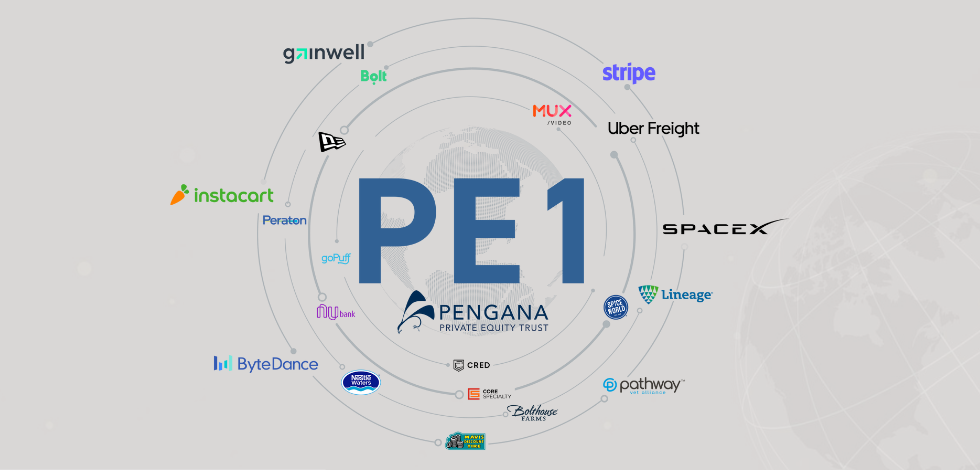
PE1 is Australia’s only globally diversified private equity fund listed on the ASX, with exposure to over 550 private companies across multiple sectors and geographies (with some past and present examples below).

+550 More
CLOSE

Why Now

A Market at an Inflection Point

Public valuations are stretched, but private equity is finding healthier ground as deal and exit activity picks up, supported by a lower cost of capital.

Structural Growth That Endures

Long-term trends continue to power opportunity:

  • Digital transformation across industries
  • Healthcare innovation
  • Resilient and sustainable business models

These themes are fueling the next wave of private market growth.

Diversification That Drives Stability

Performance now varies widely across strategies, vintages, and managers.
A balanced portfolio across buyouts, growth, secondaries, and co-investments helps:

  • Reduce concentration risk
  • Smooth returns over time
  • Capture a broader set of value creation opportunities

How PE1 Benefits

PE1 provides access to leading private equity managers and a diversified mid-market portfolio designed for sustainable long-term returns.

With a mature underlying asset base generating increasing distributions and a permanent on-market buyback supporting the value of PE1 units, the trust aims to deliver both ongoing income and enhanced shareholder outcomes.

Download Your Investor Insights on Private Equity & PE1

HARNESSING GLOBAL EXPERTISE​​*

Brought to you by Pengana Capital Group, in partnership with Chicago-based GCM Grosvenor — one of the world’s largest and most established allocators to alternative investments.

Grosvenor Capital Management, L.P. (“GCM Grosvenor”) is one of the world’s longest-standing and most diversified independent alternative asset managers. Established in 1971, GCM Grosvenor manages over US$87 billion in assets across private equity, infrastructure, real estate, credit, and absolute return strategies, with a focus on delivering customised solutions for institutional investors globally.​

25+

Years Experience in Private Markets

Proven performance across multiple market cycles.

US$31B+​

PE Assets Under Management

Deployed across more than 1,300 global investments.

1,340+

PE Investments Across Strategies and Geographies**

A global portfolio built for diversification and access.

545

PE Manager Relationships**

Access to leading and hard-to-reach private equity sponsors.

Key Fund Metrics

UNIT
PRICE (ASX)

NAV
PER UNIT5

$1.672

30/11/2025

PERFORMANCE SINCE INCEPTION2

8.8% p.a.

TARGET DISTRIBUTION YIELD1

4%

INVESTING WITH INTENTION

1

Discovery & Research

Deep Market Intelligence

Proprietary research identifies emerging opportunities across global private markets.

2

Rigorous Due Diligence

Investment and Operational Details Scrutinised

In-depth evaluation of teams, strategies, and performance.

3

Portfolio Construction

Diversified by Design

Capital deployed across buyouts, growth, secondaries, and co-investments to balance risk and return.

4

Continuous Monitoring

Assessed from Multiple Angles

Active oversight and proprietary analytics ensure alignment and long-term value.

5

Outcome

Consistent Value Creation

A proven, data-informed process delivering durable results.

THE MIDDLE MARKET OPPORTUNITY

Where opportunity, diversification, and disciplined execution meet.​

Multiple Paths to Value

Growth driven by operational improvement, digital transformation, strategic acquisitions, and international expansion - not just financial engineering.

Diversified Opportunity Set

Thousands of targets across sectors and geographies smooth outcomes and reduce reliance on single large deals.

Aligned Partnerships

Investing alongside specialist managers enables disciplined execution, alignment, and long-term results.

PE1 has a core focus on middle market private equity - Where opportunity and discipline can drive durable returns.

Lonsec Recommended Rating⁺

Independent Investment Research⁺⁺

Pengana Capital Group

GCM
Grosvenor

INVEST TODAY

UNITS IN PE1 ARE AVAILABLE ON THE ASX

Investors are missing more of the growth story than ever before. Over the past two decades, the global equity landscape has quietly transformed...

There’s an old saying: Markets climb a wall of worry But with persistent geopolitical tensions, rising economic uncertainty, and the...

Data shows that global private equity (PE) is on the rebound, yet sentiment hasn’t caught up and good discounts are...

Get closer to the world’s leading private companies.

Investing is not without risk, you can view a summary of the risks associated with the trust here.

PUBLIC MARKETS ARE JUST THE TIP OF THE ICEBERG

Join the private equity party

View PDF

Everyday investors can now enjoy the higher returns and diversification normally reserved for the wealthy

Private equity has traditionally been an exclusive asset class only available to the “big end of town” and the ultra-wealthy. But, increasingly, everyday investors, including self-managed superannuation funds, are being given the chance to hop on the global private equity bandwagon.

Private equity’s popularity has grown due to several favourable characteristics, such as its historical performance across economic cycles. It allows for value creation and long-term investment horizons, as it typically doesn’t experience the same short-term fluctuations as listed equities. It also brings an “illiquidity premium” from the nature of the underlying companies, which is attractive to investors over the longer term.

More than 70% of large institutional investors allocate funds to private equity, with the average target being about 14%. Australia’s Future Fund, for example, allocates about 16.8% of its portfolio to private equity.

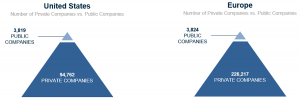
The growth of private companies has corresponded with a decline in publicly listed companies: for example, in 2000 there were 8090 listed US companies, yet by early 2022 this had more than halved to 3819.

Private equity provides the opportunity for inves- tors to vastly expand their universe of investable companies. Compared with those 3819 listed compa- nies in the US, there are 94,762 private companies. In Europe, there are 3824 listed developed market com- panies compared with 226,217 private companies.

Investors who only put their savings in listed companies are effectively restricting themselves to just 2% of companies in the world.

DIFFERENT STRATEGIES

Investing in private equity can take several forms. In Australia, investors tend to (incorrectly) associate private equity investing purely with venture capital – providing capital for start-ups. Yet venture capital is only one small part of many private equity strategies.

There is a private equity spectrum, from “angel investing” (providing very early seed money to start- ups) right through to distressed funding (buying the debt or assets of a distressed business and trying to return it to profitability).

But by far the most common private equity invest- ment strategies sit somewhere in between: through either buyouts or growth equity.

Buyouts are the most common private equity strategy, through either acquiring a controlling posi- tion in larger, more mature companies with estab- lished cashflows. Buyout managers utilise financial structuring and operating expertise to improve com- pany financials in order to position the company for a strategic sale at a higher valuation.

Growth equity involves building companies with solid, proven business models that are poised for further growth due to strong underlying demand, good management, a good balance sheet and a point of difference.

HOW IT HAS PERFORMED

Private equity has generated compelling historical returns by outperforming its listed counterparts over multiple time horizons and across geographic regions. It has also outperformed listed equity in various economic conditions and, in particular, in periods of economic stress, such as the GFC in 2008.

With private equity having generated these higher returns at lower levels of risk (as measured by return volatility) compared to listed equities over the past 20 years, there is a potential for private equity to deliver diversification benefits to investors’ portfolios, if they are able to get past the traditionally high barriers to entry. Adding even small amounts of private equity to a portfolio can potentially increase overall returns and lessen volatility.

Private equity versus shares

THE ‘VINTAGE’ CAN COUNT

Like a good wine, the year in which private equity investments are first entered into, the vintage, can have significant influence on the end result.

Private equity has escaped the worst of the market downturn in 2022, which for equities and bonds has been worse than the first half of 2008. But private equity tends to lag equities and bonds by one or two quarters, so it could face some short-term headwinds during the second half of 2022.

Market downturns tend to have a more muted impact on the valuations for private equity than listed equities, as private equity does not experience the same big fluctuations in company valuations. Until recently, prices for listed equities have been very  high compared with company earnings, yet prices for private equity buyout deals were comparatively more reasonable and stable, and therefore more appealing than listed equity counterparts, and less likely to experience severe correction.

Private equity managers can also leverage tougher market conditions to conservatively structure deals to include stronger downside protection and significant upside participation. As with timing the market, however, trying to select the best vintage can be difficult. An investor’s ability to capitalise on these vintages relies heavily on selecting the right managers, with the right connections, to do the right deals – but this raises questions around access.

INVEST FOR THE LONG TERM

Private equity is a long-term game, and its underlying access characteristics have historically been a major barrier to entry for everyday investors and even high- net-worth individuals.

It is typically accessed through newly established “primary” funds, which invest into a portfolio of underlying companies. Investors make commitments during an initial fundraising period, with the usual minimum amount of $5 million to $10 million serving as a roadblock for many investors.

The identification, due diligence and selection of managers at the outset are paramount for a successful investment: there is a clear performance gulf  between the top-quartile and median private equity funds, much more so than their listed equivalents.

Gaining access to top-quartile funds is, therefore, vital to achieving consistent performance.

But it’s not easy. Not only do the best private equity managers not need your money, in many cases they don’t even want your money – the demand for their expertise is so great that many of the top-quartile managers’ new funds are oversubscribed before they even open for investment.

Many private equity funds have a life of 10 years or more, although some investments may see some realisations after five to seven years. They are specifically structured to be illiquid.

Even high-net-worth individuals struggle to create their own sufficiently diversified private equity portfolios – a well-structured, diversified private equity program may require upwards of $100 million in capital, considering the high minimum investment to access a single fund manager.

Private equity firms with capital to deploy are able to buy distressed assets at attractive prices

HOW TO GAIN ACCESS

Until recently, private equity has really been the domain of the uber wealthy or big institutional investors, such as the Future Fund.

But everyday investors are starting to gain access.

In 2019, Pengana Capital Group announced a partnership with the US-based GCM Grosvenor, a $US71 billion ($105 billion) private equity powerhouse, to launch the ASX-listed Pengana Private Equity Trust (PE1).

This solves the access issues, with everyday and self-managed super fund investors now able to invest in a diversified portfolio of global private equity, with low barriers to entry and daily liquidity made availa- ble through an ASX-listed investment trust structure.

The trust offers investors a single point of entry to a global portfolio of more than 400 underlying private companies, with an expectation that this will further increase to more than 500 over time, as new primary funds are added the underlying portfolio.

The trust is further diversified through exposure to deals across economic cycles that span from 2003 to the present day, and has utilised a range of private equity strategies and implementation methods. It focuses on the middle market – companies with enterprise values of $US500 million to $US1.5 billion, and avoids investments in venture capital.

The trust recently reported a net return of 26.7% for 2021-22. Since inception to June 30, 2022, it has delivered a 13.4%pa net return on its net asset value.

THEY LOVE A RECESSION

More companies are choosing to remain in private hands, yet they may still require capital. They still need to refresh their shareholder base, and they need to expand their businesses, which has the potential to provide an enormous opportunity for investors who can access this part of the market.

There’s a saying in private equity circles: “private equity managers love a good recession”. Recent history has shown that while private equity has outperformed listed equity across all stages of the economic cycle, this effect is magnified during, and immediately following, recessionary periods.

Historically, private equity firms with capital to deploy are able to buy distressed and/or undervalued assets at attractive prices.

Middle-market companies are currently particularly attractive in private equity because they have a broader range of exit options, including trade sales, management buyouts or sales to other private equity funds. They don’t need to rely on initial public offerings (IPOs), which is a good thing, as IPOs have dropped off this year. The other great advantage of middle-market companies is the ability to secure favourable terms for additional rounds of venture capital raising.

Private equity has been particularly active in recession-resistant industries, such as consumer staples, healthcare and utilities, which are holding up relatively well. Continued outperformance will likely depend on targeting pockets of stability and opportunity alongside the right managers, with a focus on profitable companies in defensive and attractive industries including consumer staples, government services, IT, logistics and healthcare.

Russel Pillemer is CEO of Pengana Capital Group.

PE1’s largest ever distribution

The Board of Pengana Investment Management Limited has declared an upcoming half-yearly distribution to be paid to unitholders as follows:

Distribution: 3.243 cents per PE1 unit held

To unitholders on the PE1 register, as at the record date: 4 July 2022

Paid on: 15 July 2022

We are pleased to be able to pay our unitholders PE1’s largest ever distribution, in particular at a time of stress in equity markets. We believe that including high quality private equity holdings as part of a diversified portfolio will continue to add value to our investors’ portfolios through the current environment.

PE1 has increased its distributions paid to unitholders in every year since listing in 2019.


More About PE1
The Pengana Private Equity Trust (ASX: PE1) is a diversified portfolio of global private market investments, with a select allocation to private credit and opportunistic investments.

The portfolio is managed by one of the largest and longest continually operating allocators to alternative investments in the world, Grosvenor Capital Management L.P.

PE1 aims to provide investors with access to the top-performing quartile of global private equity managers, and generate attractive returns and capital growth through a selective and diversified approach to private market investments over an investment horizon of at least 10 years.

PE1 boasts exposure to over 350 underlying private companies.

Investing in great tech companies Pre-IPO

Investors are clamoring to buy into listed global technology companies – on the Nasdaq, the ASX, and other exchanges worldwide, driving valuations to all-time highs.

And then there are unlisted global technology companies, many of which have phenomenal growth prospects but are valued at much lower multiples than their public market counterparts. Unfortunately for most investors, it is impossible to invest in these unlisted companies which usually only raise money from large institutions and extremely wealthy family offices – who get to share in what is often substantial gains, when these companies are listed or sold.

FORTUNATELY FOR AUSTRALIAN INVESTORS, THEY CAN NOW INVEST IN MANY OF THESE COMPANIES VIA THE ASX BY ACQUIRING UNITS IN THE PENGANA PRIVATE EQUITY TRUST.

PE1

Examples of market-leading, unlisted, global technology companies that are owned by PE1 include:


Instacart
: the leading independent grocery delivery platform in the US and the largest single investment in the PE1 portfolio. Instacart which has had 500% volume growth over the last year, is reported to be targeting an IPO in the first half of 2021.

Stripe: a payment processing company with software that allows businesses to make and receive payments, primarily in e-commerce environments. We believe that Stripe is the globally preferred solution for both e-commerce and software as a service (SaaS) companies.


ByteDance
: the second-largest internet platform in China and owner of TikTok. The company has 800 million daily average online users of its video, live streaming, and newsfeed apps, accounting for 12% of time spent online in China. Recently reported to be raising an additional US$2 billion, valuing it at circa $180 billion.


Transferwise: a payment platform launched in 2011, designed to provide its customers with the lowest possible costs on foreign currency transfers. With 8 million customers, Transferwise employs 2,200 people across 14 offices globally and processes in excess of US$5 billion of transfers per month.


Transact
: a payment and campus management software platform operating in the higher education market, serving ~1,300 unique institutions and over 12 million students globally.


Nubank
: a Brazilian company that is the largest Fintech in Latin America, offering credit cards, personal loans and savings accounts by smartphone without the need for physical documents and branch visits. Nubank has 23 million unique customers, equating to 14% of Brazil’s adult population.


SpaceX
: an American aerospace manufacturer and space transportation services company founded in 2002 by Elon Musk, with the goal of reducing space transportation costs to enable the colonization of Mars.

Uber Freight: an UBER-for-freight-logistics app that helps carriers make hassle-free bookings and shippers tender shipments easily.

Let’s take a look at a recent example of a pre-IPO investment that Australian retail investors who hold PE1 were able to access.

Unity software is a mobile game development platform operating in a global duopoly with an increasing market share in a rapidly growing market. The Unity platform boasts 1.5 million active creators, over 3 Billion app downloads per month, with over 50% of all mobile games in the world being created using Unity’s platform.

In September of 2019 PE1 invested in Unity at a price of $22 per share. In September of 2020, Unity executed an IPO at $52 per share and is now valued at circa $95 per share (as at end of October 2020). PE1 still holds in investment in Unity which is currently worth 4.3x its entry price.

PE1 is listed on the Australian Stock Exchange (“ASX”) and therefore is accessible to investors who are able to acquire ASX listed investments.

In addition, most major investment platforms allow their investors to invest in PE1 units.

Speak to your financial advisor about an investment in PE1 or contact us directly.


Disclaimer:

Whilst PE1 has the potential to generate returns from investing pre-IPO, it is important to note the following:

  • PE1 has a highly diversified portfolio and therefore, only a minority of PE1’s investments will be in technology companies. Furthermore, it is expected that PE1 will exit only a minority of such investments through the public markets
  • PE1 does not have a concentrated portfolio and therefore any single investment is unlikely to have a major impact on PE1’s investment performance
  • There are risks from investing in every company and there are prospects of generating negative returns from any investment.

Pengana Investment Management Limited (ABN 69 063 081 612, AFSL 219 462) (“Pengana”) is the issuer of units in the Pengana Private Equity Trust (ARSN 630 923 643) (“Trust”). A Product Disclosure Statement for the Trust (“PDS”) is available and can be obtained by contacting Pengana on (02) 8524 9900 or from www.pengana.com. A person who is considering investing in the Trust should obtain a copy of the PDS and should consider the PDS carefully and consult with their financial adviser to determine whether the Trust is appropriate for them before deciding whether to invest in, or to continue to hold, units in the Trust.

This report was prepared by Pengana and does not contain any investment recommendation or investment advice. None of Pengana, Grosvenor Capital Management, L.P., nor any of their related entities, directors, partners or officers guarantees the performance of, or the repayment of capital, or income invested in the Trust.

Certain statements in this report constitute Pengana’s opinions on investment related matters. While Pengana has a reasonable basis for holding these opinions these do involve known and unknown risks, uncertainties, assumptions and other important factors, many of which are beyond the control of Pengana and which may cause actual performance or outcomes to differ materially from those expressed or implied by such opinions. To the maximum extent permitted by law, Pengana disclaims any obligation to disseminate any updates or revisions to Pengana’s opinions as expressed in this report.

An investment in the Trust is subject to investment risk including a possible delay in repayment and loss of income and principal invested. Past performance is not a reliable indicator of future performance, the value of investments can go up and down.

Three key reasons to hold PE1 in your SMSF

Attractive long-term performance coupled with lower risk and lower correlation to listed equities, as well as improved resilience through market cycles, makes this once hard-to-access asset class increasingly important.

Given their ongoing quest to diversify their investments, private equity has been on self-managed super fund (SMSF) members’ radars for some time. Many Self Managed Super Funds started to take notice of this attractive asset class when Australia’s sovereign wealth fund, the Future Fund, was reported to have increased its allocation to private equity to over 16 percent of its assets in early 2021. 

 In the past, it has been extremely difficult for the vast majority of investors to access private equity due to a number of barriers to entry. As an asset class, private equity, by definition, is an alternative path for companies to raise capital and pursue growth opportunities outside of listing on public markets. Now, there is a way for SMSFs to more easily invest in private equity, eliminating the traditional unavailability of this exciting asset class, 

Pengana Capital Group’s Private Equity Trust (trading on the ASX under the ticker ‘PE1’), makes units in a globally diversified portfolio of carefully screened private equity investments available for access through the Australian Securities Exchange. In turn, giving SMSF members a unique vehicle to gain exposure to this important and growing part of the capital markets. The PE1 portfolio of private market investments is managed by Grosvenor Capital Management LP, one of the largest and most diversified independent asset managers in the world, with over US$67 billion in assets under management.  

In order to determine whether listed private equity fits into your SMSF’s asset allocation, it is important to fully appreciate private equity’s unique characteristics.  

Here, we explore three reasons why private equity is a compelling proposition for SMSF investors. 

1. See more than just the tip of the iceberg  

Of all companies in US and European markets with annual revenues in excess of US$10 million, only 2 percent are publicly listed, and this cohort is shrinking.  

While in 2000, there were approximately 9,000 listed companies in the US, by 2019 this had reduced to a little over 4200. This universe has dwindled as the rules and regulations imposed on listed companies have become increasingly onerous and costly.   

Ultimately, investors who are only exposed to listed companies are effectively ignoring 98 percent of the opportunities in the world, which are private companies.

As more and more companies now choose to remain in private hands, they still require capital. “These companies still need to refresh their shareholder base and they need to expand their businesses, which is an enormous opportunity for SMSF investors,” says Pengana CEO Russel Pillemer.  

Moreover, listed equities are just one of many asset classes. So, global private equity gives SMSF investors the potential to diversify their holdings not just outside the Australian and global equities markets, but across asset classes.

2. A different asset class to listed equities, with less correlated returns.

Many balanced SMSFs will have considerable exposure to equities, in fact, the latest ATO figures show that, on average, 26 percent of all SMSF assets are equities1. One of the ways to diversify some of the risks of this often-volatile asset class is through exposure to private equity. Historically, private equity has been much more resilient than listed equities during sharp market corrections. 

“A good private equity manager loves a good recession,” says Grosvenor Capital managing director Aris Hatch. “Being privately-held, asset values are not subject to market swings, and managers of these investments are not trying to ‘beat the street’ on any given day. During a crisis, they are able to slash costs, drive efficiencies, and inject capital, without worrying about share prices,” she adds.  

Hatch explains over the past 20 years, the best private equity funds have been formed during a down market, to take advantage of favourable asset prices. “Putting money to work during a recession means we are able to buy companies at a discount and sell them when markets and multiples heat up.”  

It is worth noting, since the market crash in March of 2020, 6 of PE1’s investments have been named in the top 10 of the world’s largest private companies with valuations over US$1bn (Instacart (US), Stripe (US), SpaceX (US), ByteDance (China), Nubank (Brazil), and Rivian (US)) which form part of an over 350-company-strong portfolio of companies.

3. Investment objectives and timelines are in sync with many SMSF investors 

An alignment of goals, and timing, is the third reason SMSF investors are increasingly exploring private equity. Many have longer-term investment horizons that match those of private equity returns, and a corresponding intention to generate strong returns with low levels of risk over time. 

Pengana’s Private Equity Trust (ASX: PE1) offers an additional level of protection and investor benefits. While the assets in the fund overcome many of the challenges of traditional private equity investments, investors can easily buy and sell units on the listed market (of course, like all listed equities, subject to an active market of willing buyers and sellers), and are afforded the additional protections listed vehicles offer, such as continuous disclosure obligations. 

In sum, PE1 delivers investors a high-quality and highly diversified portfolio of global private equity assets in a listed form, managed by one of the world’s largest and most diversified independent asset managers.  

In an uncertain world, PE1 is an opportunity few SMSF trustees can ignore. 

To learn more about PE1, please visit the Fund page HE

Private equity’s role in a well-constructed portfolio

The original article was published in firstlinks 24-March-2022, and is available HERE

The $200 billion Future Fund is not alone in its enthusiasm for private market investments. One of the most significant financial trends since the turn of the century has been the explosive growth in private markets.

Private Equity is the cornerstone of the Future Fund’s illiquid portfolio, accounting for 16.8% of total portfolio allocations, second in size only to their global listed equities portfolio (including both developed and emerging markets).

Meanwhile, Calpers, Americas largest public pension fund, has announced an intention to increase exposure to private equity and private debt from 8% to 18% as we see the acceleration of a well-established trend: Morgan Stanley says US companies (the largest market for private investments) have raised more money in private markets than in public markets each year since 2009.

The magnitude of the ongoing opportunity is still emerging, as private markets are significantly larger than public markets, according to the S&P Capital IQ database.

Companies with revenues ≥ US$15 million


Understanding Private Equity

Private equity refers to capital invested in companies that are not listed on public exchanges. Such investments can be made at any stage during the corporate life cycle.

The characteristics, risk, and potential return of private equity investments typically vary according to the stage at which the investment is made, with most investments being made once companies are more mature and validated:

Angel Investing is initial private funding support often backing little more than an idea and an entrepreneur.

Venture Capital is where managers actively work with early-stage or start-up investments to develop the business to raise further capital to fund commercialisation.

Growth Capital generally follows the venture capital stages as companies with viable business models and proven demand prepare for success on a larger scale. An increasing portion of growth capital funds customer acquisition.

Buyouts are the largest private equity segment. Transactions involve buying all, or a controlling stake, of a mature company with intention to improve its business and financial health, later reselling it for a profit to an interested party or conducting an IPO. Such transactions are often called leveraged buyouts as predictable future cashflows are ‘leveraged’ such that the acquisition can largely be debt financed, thereby bolstering investor returns.

Distressed funding is niche and generally involves acquiring the debt, equity or assets of a distressed business with the intention to restructure, recapitalise, and return to profitability.

Most private equity funds have an investment term of 10-12 years with only a small portion of the committed capital generally required upfront. The investments are typically made during the first five years with the realisations occurring later in the life of the fund.

What’s in it for investors?

Since the GFC, more companies have chosen to stay private rather than list on public exchanges as the regulatory burden for listed companies has become increasingly onerous and the funding options for unlisted businesses have improved.

Investors are attracted to private equity for:

  1. Proven ability to deliver strong risk-adjusted returns
  2. Resilience displayed during market turmoil

Private equity’s lower correlation with listed equities has become more relevant as investors seek to diversify away from heightened valuations in global equities, and anaemic cash returns.

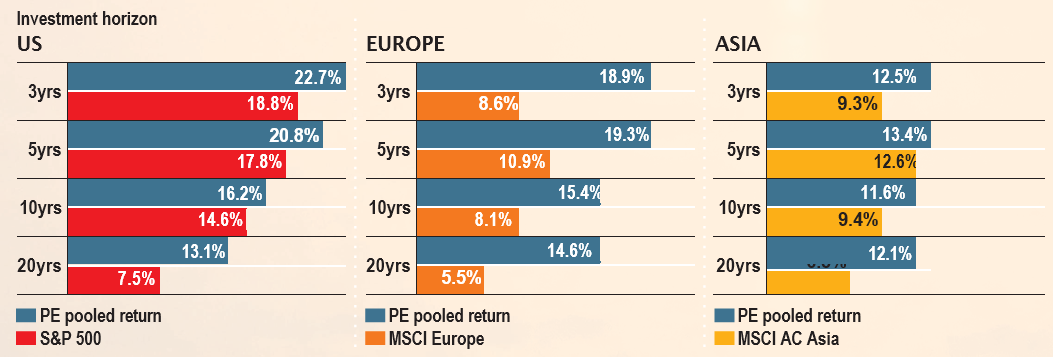
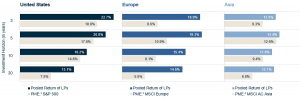
The charts below illustrates how private equity has outperformed listed equity across time horizons and geographic regions. There is also greater variation in performance among managers when compared with listed equity funds, meaning investors who commit to top-tier private equity managers can expect to capture much greater levels of outperformance than the averaged-out returns displayed below.

1 The Public Market Equivalent (“PME”) concept allows investors to compare the performance of private equity and other private markets investments (Private Equity) to other types of investments, such as public market indices (Public Equity). The methodology assumes buying and selling a given index according to the timing and size of the cash flows between the investor and the private investment. Performing this comparison requires the construction of a hypothetical investment fund that mimics private equity cash flows. This hypothetical fund purchases and sells shares of the index at the same time the private equity vehicle calls and distributes cash.

Sources: MSCI, S&P and BURGISS

Overcoming the challenges of Private Equity investing

The benefits of investing in private equity have traditionally accrued to institutional, wholesale, and ultra-high net worth investors who are better placed to manage the traditional complexities associated with investments in the asset class.

This changed in 2019, when Pengana Capital Group listed the Pengana Private Equity Trust (ASX:PE1), a listed private equity vehicle specifically designed to enable everyday retail investors to overcome the many barriers in accessing private equity.

The LIC structure is most appropriate for listed private equity because it allows an investment manager to unitise illiquid underlying investments into shares and list on the market. This structure solves several challenges of private equity investing, including:

High barriers to entry: Private equity fundraisings are extremely exclusive with significant excess demand for top managers; PE1 partnered with US-based GCM Grosvenor to leverage existing access via a well-established private equity manager with long-standing relationships, which provides exposure to these difficult-to-access private equity opportunities.

Capital constraints and high minimum investment requirements: Typical private equity funds may require a minimum of $5-10 million for a single investment. PE1 provides access to a truly diversified portfolio of private equity investments across underlying investment managers, economic conditions, vintages, geographies, sectors, and strategies (PE1 has exposure to nearly 400 underlying companies).

Highly illiquid: Existing private equity vehicles lack liquidity with an average 10-year capital lock up. But the LIC structure means PE1 investors have daily liquidity on the ASX.

Complex cash-flow management: Traditional private equity funds require capital to be contributed on a drawdown basis and exhibit lumpy returns as investments are realised and funds wound up. Yet the listed investment trust structure allows for internally managed cashflows, with drawdowns and distributions managed by the portfolio manager. Distributions are further reinvested to gain new private equity exposures.

No regular distributions: Regular distributions are a challenge for traditional unlisted private equity, yet PE1 can target a 4% p.a. distribution paid semi-annually.

Why private equity is becoming more relevant

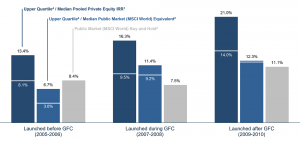
In its Global Private Equity Report 2021, Bain and Company shows that one of private equity’s enduring strengths is its ability to thrive during periods of economic disruption with downturns historically providing excellent investment opportunities. This is particularly evident when assessing the returns (IRRs in the 17 – 21% range) of funds established in 2002 and 2009 following the last economic downturns.

All current evidence indicates inflation is likely to remain elevated, with potential for huge spikes following Putin’s invasion of Ukraine. Global interest rates could march steadily higher. This will put pressure on businesses with excessive leverage and valuations.

In the private markets, these characteristics are typically associated with the very large funds and mega transactions where the deal terms reflect the intense competition to deploy vast amounts of capital. Middle market transactions are typically completed with lower levels of leverage, and at lower valuations, which should provide a measure of additional protection in a rising rate environment.

The recent inflation shock presents a unique opportunity for private equity managers to offer solutions to high quality businesses that require continued financing and structuring them to include strong downside protection for investors while preserving meaningful upside.


Russel Pillemer is co-founder and Chief Executive Officer of Pengana Capital Groupwhich operates the Pengana Private Equity Trust (ASX: PE1). This article is general information and does not consider the circumstances of any investor.